

You need a car for the next few months. Maybe you moved to Athens for work. Maybe your car is in the garage and the insurance company is looking at it. You may be here for the season and you're in no mood to sign a 24-month lease for a car you didn't even pick. So you start looking. Traditional rental? €40—60 a day — okay for a weekend, unbearable for a month. Leasing; If you like locking down warranties, commit for 12 months, and drive whatever they give you from a “category”. There's a better way. It is called Car as a Service— and it changes the whole equation.
What does “Car as a Service” mean in practice
Car as a Service (CaaS) is exactly what it sounds like: you get a car like you get any other modern service. One monthly price. All included. No long-term commitment. And, here's what most people lose, you choose the accurateThe car you want. Think about how software went from buying CDs in a store, to subscribing to the tools you need and stopping whenever you want. CaaS does the same thing in mobility. Instead of buying, financing or leasing a car that is losing value, you simply subscribe to the car that fits your life right now—and change it when your life changes.
Let's see how CaaS compares to what you know:
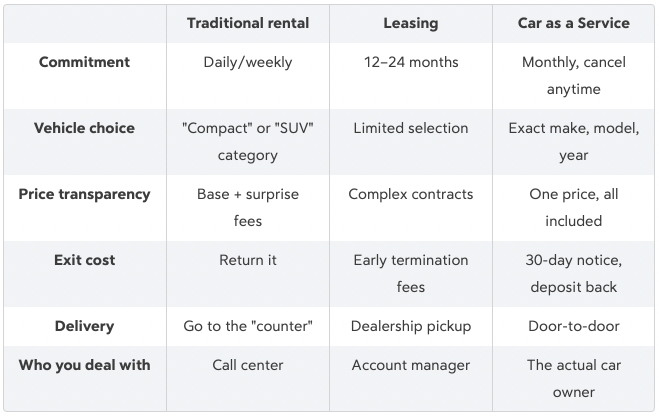
The difference is not in shades. It's structural.
Why now? The transition from ownership to access
The global leasing and flexible mobility market is expected to reach $30 billion by 2030. In Greece, the change is even more pronounced — a country where car ownership costs a lot, MMM outside Athens is limited, and seasonal demand creates huge gaps that traditional models cannot fill.Three forces converge:Finances don't work anymore.The average car in Greece stays parked 95% of the time. The owner pays insurance, tolls, maintenance and depreciation — whether the car is moving or not. For renters, daily rent is very expensive and leasing very rigid.Consumer expectations have changed.Those who subscribe to their music, software, and shopping aren't going to put up with 24-month contracts for a car they've never seen before. They want flexibility, transparency, control.Technology has made it possible.The infrastructure for peer-to-peer car sharing — secure payments, digital contracts, authentication, remote unlock, real-time availability — did not exist five years ago. Now there is.
The 6 pillars of the real Car as a Service
Not what is advertised as “Car as a Service” really is. Some companies use the term loosely — a leasing contract with a monthly fee is not a service, it is leasing with better PR. True CaaS stands on six pillars:
1. Precise car selection
You don't take “blame.” You don't get “or similar”. You see real cars — specific make, model, year, color, engine — and close what you want.A new parent needs something completely different than someone who does 2,000 miles a month. A photographer in Crete needs something different than a consultant in Thessaloniki. CaaS respects this.
2. Door-to-door delivery
The “counter” is dead. In a true CaaS model, the car comes to you — at your home, at the office, at the airport. No shuttle bus in parking lot. No 45-minute queue. Without discovering that your “reservation” did not mean that they actually saved you a car.Delivery is not a premium extra. It's the base.
3. One price, everything inside
Security. Traffic Fees. Roadside Assistance. Maintenance coverage. One number a month. No asterisks, no “administrative costs”, no surprises on the invoice.When someone asks “how much does it cost?” — the answer should be a number, not a paragraph.
4. Freedom to stay or leave
This is where real CaaS separates from leasing-in-disguise. The question is not “what is the minimum commitment?” — that's what everyone says now, a month. The question is: What does it really cost to leave?Some people lock your warranty for 28 months after cancellation. Others make the prepayment non-refundable. Others ask for 20 working days notice — calculated so that you always pay a month over.True CaaS means: you give notice, you get a refund, unused months are returned. No penalties. No tricks.
5. Personal service from real people
There's a reason Airbnb reviews talk about the host, not the platform. When the person who gives you the keys is the owner of the car, he cares about your experience in a way that no call center will ever care.In a CaaS model that relies on private providers, you get a direct human relationship. Someone who will explain the vagaries of the car, suggest parking near your office, or bring you a spare key if you lose yours. No script. No ticket number.
6. Geographic coverage beyond urban centers
Traditional rental and leasing companies are concentrated in airports and city centers because that's where their infrastructure is. But people don't need a car just in the Constitution. A true Car as a Service model — especially one that relies on local Providers across the country — puts cars where people actually live and work: islands, smaller towns, neighborhoods that no fleet company would ever branch out.
Who is Car as a Service for?
CaaS is not for everyone. If you've been driving the same car for five years without thinking about it, buy one. If you need a car for a weekend, rent one. But there is a huge group of people in between — and no one has been serving them properly for years:
- Expats and movers.You just came to Greece for work. You need a car right away, but you don't know if you'll stay 6 months or 3 years. Leasing locks you in. The daily rent bleeds you. CaaS gives you a car this week and lets you see the rest after.
- Greeks in transition.You sold your old car and you haven't bought a new one yet. Or it is in major repair. Or you're waiting for a delivery that's constantly delayed. You need something reliable for 1-3 months, and you don't want to pay daily rates.
- Seasonal workers and digital nomads.Athens in winter, Crete in summer, Thessaloniki in between. Your mobility needs change with your life. CaaS changes with you — another car, another city, same simplicity.
The economics behind Car as a Service
Why can CaaS offer better prices with more flexibility? It comes down to one word: ownership — or rather, the absence of it.Fleet-based leasing companies buy thousands of cars. Loans, amortization, security on scale, parking lots, maintenance centers, personnel. All of this goes into your monthly price — along with a margin that justifies the capital risk.A peer-to-peer CaaS marketplace turns everything upside down. Cars already exist — they are owned by individuals and small businesses who already pay insurance, fees, parking. The platform gives technology, trust infrastructures, and customers. The Provider gives the car and service. This means:
- Lower basic costs— no fleet purchase debt
- More flexibility— no need to lock customers in order to amortize
- Best Cars— Providers offer their actual vehicles, not fleet-spec base models
- Wider coverageProviders are everywhere, not just where it is convenient to open a branch
The result is a fundamentally different cost structure—one that passes the benefits to both sides.
What to Look for in a CaaS Provider
If you're evaluating CaaS options, keep this list:Do you see the exact car before you book?If you choose from “Economy” or “SUV” categories, this is rental, not CaaS.Is the price really all-inclusive?Ask about security, fees, roadside assistance, delivery costs. If the answer contains footnotes, look elsewhere.What happens when you cancel?This is the most important question. Ask specifically: how many days notice? When do you get a guarantee back? Is the prepayment refundable? This is where the fine print lives.Who do you talk to when something goes wrong?Call center with standby music or a real person who knows which car you drive?Can you find a car outside Athens?If the service only works in one city, it's not Car as a Service — it's a city subscription.
The future of mobility in Greece
Greece has a unique position for the CaaS model. High ownership costs, strong seasonal demand, a tourism economy that generates natural supply (cars idle in winter), and an increasingly digital-first consumer base.The traditional rental market in Greece exceeds one billion euros a year — and the vast majority of that revenue goes to a handful of multinationals. CaaS, especially in its peer-to-peer form, can redistribute this value: giving car owners a real source of income, while giving renters a better product at a better price.It's not a fuss story. It's a correction. The rental car model was built in the 60s for a world of counters and carbon contracts. The world moved on. Mobility must follow.
Try Car as a Service
See available cars at ~Sync~ — the peer-to-peer car rental platform in Greece. Pick exactly the car you want, pick it up at your door, and pay a monthly rate with everything in it. Stay as long as you need. Leave when you want.
No “counter”. No “category”. No fine print.
Sync is a peer-to-peer car rental marketplace in Athens, Thessaloniki, Crete and the Greek Islands. Our Providers offer specific vehicles — not categories — with door-to-door delivery, an all-inclusive monthly rate, and freedom to cancel with 30 days notice.



.webp)